Menemukan Kembali Jaranan di Publik Urban

Menemukan Kembali Jaranan di Publik Urban

Dhanang Pradipta adalah seorang pengabdi artistik–videografi-fotografi | Ia memiliki fokus pada domain kuliner, seni-budaya, dan sejarah []

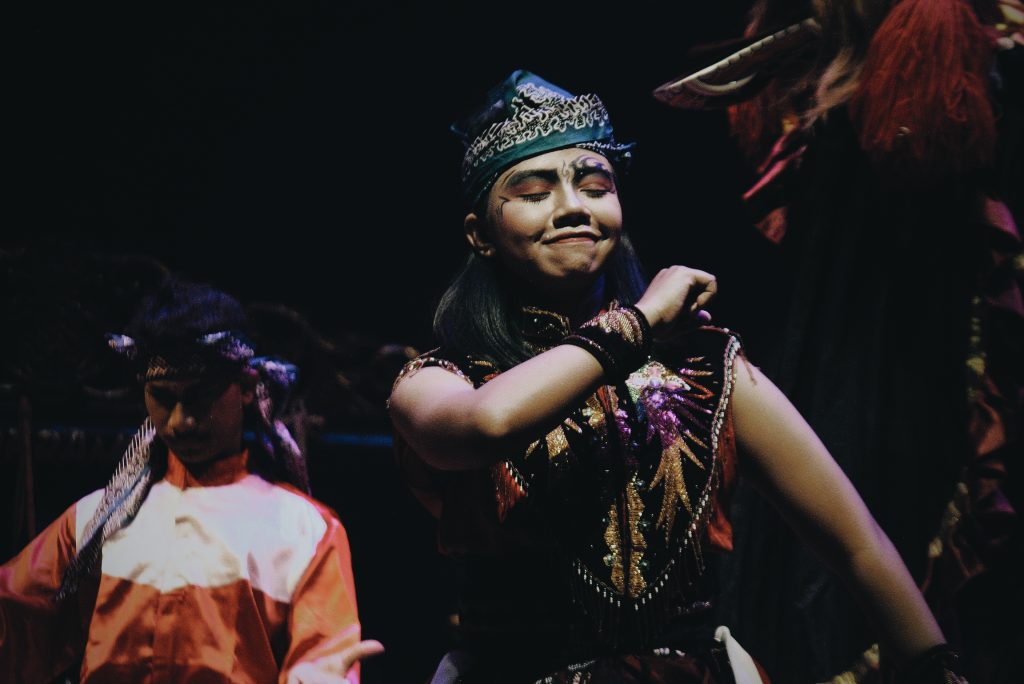
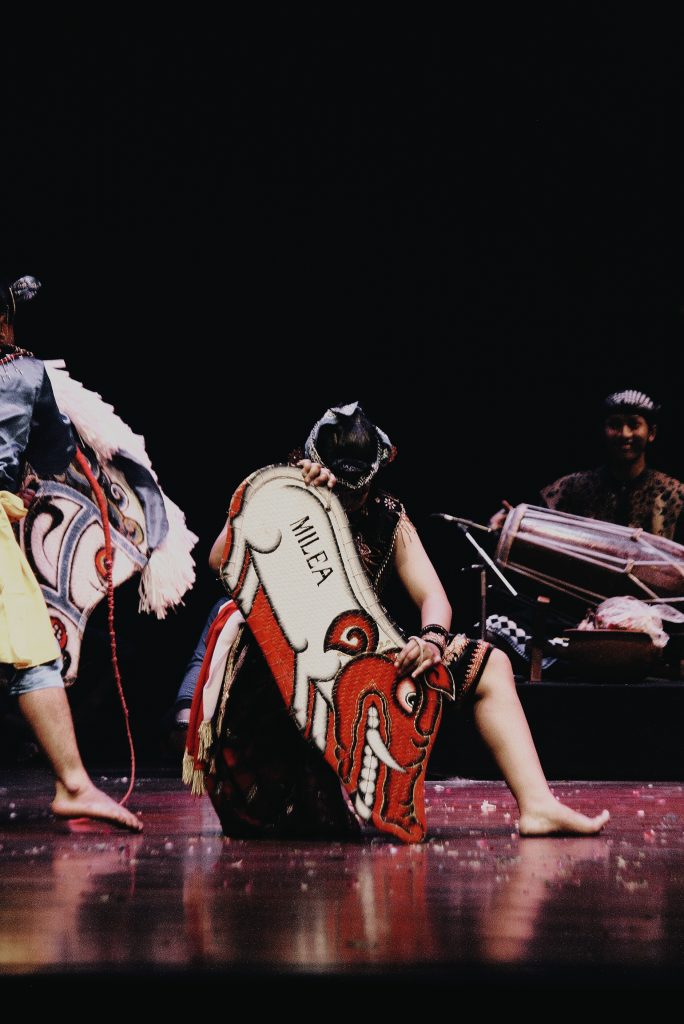
Kesenian Jaranan kembali lagi ke hadapan publik urban. Itu dapat dilihat melalui pagelaran kelompok Jaranan pada Workshop Seni-Budaya 2019 di Surabaya.

Foto ini menceritakan pagelaran kesenian Jaranan yang muncul di publik urban. Sebab, di tengah kehidupan perkotaan sekarang, kesenian ini tidak pernah lagi melakukan pagelaran di tengah perkotaan, seperti ini. Kelompok-kelompok tersebut selalu mengadakan pagelaran di daerah pinggiran kota Surabaya, atau bahkan hanya di sanggar-sanggar saja. Oleh Karenanya, momen pagelaran kelompok ludruk ini harus diabadikan dalam bentuk fotografi. Karya ini sekaligus menandai kemunculan kembali kesenian Jaranan ke hadapan khalayak umum.

Cerita ini perlu dinarasikan kembali dalam berbagai bentuk sebab, kesenian Jaranan menyimpan kesadaran atas kehidupan berbudaya masyarakat. Adapun, dalam beberapa versi, kesenian ini mengandung cerita hal-ihwal pernikahan Klono Sewandono dengan Dewi Songgo Langit.

Berikut adalah hasil dokumentasi dalam bentuk fotografi atas Pagelaran Kelompok Jaranan pada acara Workshop Seni-Budaya 2019 di Surabaya.

Arek on The Pre-Colonial Era

Arek on The Pre-Colonial Era

Anugrah Yulianto Rachman–Nugi. Peneliti Arek Institute.

Indonesian researchers and writers have always marked the pre-colonial era as the initial period of the formation of Arek culture. This can be observed through two writings that attempt to trace the formation of this culture during that episode. The first article is by Autar Abdillah titled “Hybridity of the Javanese Arek Cultural Meeting” (2007) and the second work by Akhudiat titled “Arek Culture” in his book “Entering and Exiting Villages” (2008).

In Autar’s article, he aims to prove that Arek values have emerged since the period 1037-1468. This is evidenced by natural phenomena that caused geographical landscape changes in the Arek culture distribution area. Because, around that period, Mount Kelud erupted as many as 22 times. These eruptions had an impact on the Arek culture area, Surabaya.

The eruptions caused Surabaya at that time to be covered with cold lava from the eruption. Autar presents a map of Surabaya once drawn by Faber, showing that originally, Surabaya was an area formed of island clusters or deltas. Consequently, the eruption caused the deltas, separated by rivers, to be covered and become a unified area. This landscape change also influenced the formation of the Arek Surabaya character.

The character, created from this geographical landscape, is the characteristic of the Arek community known to be tough, loud, and brave. This character emerged from the island or delta formation of this subculture area. Because of the geographical condition of their environment, separated by rivers, the Arek community was accustomed to speaking loudly and boldly. This also formed the character or characteristics of Arek culture.

According to him, Arek culture’s character is not only caused by natural phenomena but also influenced by the familiar term Arek or Rek. He attempts to trace this based on the term Arek derived from Old Javanese language. For him, the term emerged from the root word Ari, which means younger brother, younger sister, or even someone who is not a relative.

Moreover, the term Ari is also connected to the Kawi noun meaning adhi, aryi, ari-ari, aruuman. Apparently, the term Ari is also preserved in Kawi language. Not stopping there, he also observes the change in the term Arek that occurred in this term. In Old Javanese, Ari-Ika or arika changed its meaning to Arek. However, it has the same meaning, which is sibling (ari-ari riko).

This means, the greeting pattern in the Arek subculture already contains the meaning of brotherhood. This is further strengthened by the spirit of togetherness in this subculture. For Autar, this value is shown when someone comes to visit, they will be welcomed as if at their own home. This value is not only contained in the familiar greeting Arek, but it is also preserved in other forms, such as Sinoman Suroboyo.

On the other hand, the tracing done by Autar has also received a response from Akhudiat. Akhudiat attempts to trace the formation process of Arek culture before the conquest by Mataram. Because Surabaya, as the central locus of Arek culture distribution, was once influenced by the presence of Raden Rahmat (Sunan Ampel). This is shown from the political relations within Sunan Ampel’s family.

Sunan Ampel’s aunt, Darawati, had a close relationship with Prabu Kertawijaya—ruler of Majapahit. Due to her closeness with the ruler of Majapahit, he was given the mandate to secure the Ampel Denta area on the north coast of Surabaya in the 15th century. From there, he received the title Sunan Ampel. Simultaneously, the area became the central locus of Islamization in Surabaya.

Sunan Ampel’s presence, in order to secure the area, indeed had an influence on the development of Arek culture at that time. Because Surabaya, as an area under Majapahit’s control, also absorbed values from the kingdom’s culture. That culture is the characteristic of language that does not have a hierarchy.

Majapahit introduced to Arek culture the form of egalitarian language. This language had a closeness with the values adopted by the Arek community. This also has similarities with the pattern of Islamic teachings during Sunan Ampel’s period. Because when introducing Islam in Java, the community was more introduced to the Arabic language in the form of Arabic Pegon (Bald Arabic).

The egalitarian language pattern, in the method of teaching Islam through Pegon Arabic, intersects with the Islamization process in Arek culture. This indicates that the formation of Arek culture had already occurred since the period before the subjugation by Mataram. The entry of Sunan Ampel also had implications for this culture. The impact was the mixing of Islam with Arek Culture.

Due to the closeness of these language values, Arek culture had a profound impact on its life. This impact led to the creation of different characteristics within the Arek culture. This difference is marked by the segregation of the Arek community, such as Arek Lor-loran (mosque and tomb of Ampel) with Arek Kidulan (Wonokromo). Both characterize the life characteristics of the white (putihan) and the abangan communities.

On one hand, based on the Islamization process, Akhudiat attempts to prove that the period before the subjugation by Mataram also had an impact on the formation of Arek culture. This is shown from various phenomena of Islamization and segregation of Arek culture during that period. On the other hand, Autar Abdillah tries to prove the formation of this culture in the period 1037-1468. Both individuals complement each other’s research areas.

Therefore, both studies provide a significant insight into the period of formation of Arek culture in the pre-colonial era. They support and illustrate the study of Arek (Arek Studies). This also shows that the formation of the Arek subculture has gradually evolved since that period.

In summary, Arek, as a culture, has formed itself long before the phenomenon of colonialism. Its formation was influenced by various phenomena, such as natural phenomena, linguistics, and even Islamization.

The Colonial Economy in Surabaya

The Colonial Economy in Surabaya

Aria Raharja Hidayat. Peneliti Arek Institute.

Surabaya, known as an industrial city, is a result of Dutch colonial formation. Industry has changed the economic pattern of Arek Surabaya in the 19th century. This construction led to the structural marginalization of Surabaya’s residents in terms of employment. It took a considerable time for Arek Surabaya to rise and follow the pace of industrialization during that era.

Initially, Surabaya was a settlement with an agrarian economic pattern since being controlled by the Mataram Kingdom (Lombard, 2000: 57). The majority of its society worked as farmers with extensive areas of rice fields and fields. Despite this, Surabaya was also a trade center (Ampel Denta) but was less bustling compared to the port of Gresik, where the VOC had been trading spices at that time.

After the dissolution of the VOC (1799) as a major trading company in Southeast Asia, Indonesia was taken over by the Dutch colonial government. From this transfer of power, Gresik was no longer an international trade route, instead, Surabaya was made the next trading port city (Basundoro, 2001: 153). During this time, Surabaya began to transition from agrarian to industrialization in the early 19th century (pre-industrial era). This can be seen from the emergence of large-scale industries, namely the Weapons Factory and weapons equipment. At this time, Surabaya began to see new industries emerging. So, when was Surabaya nicknamed as an industrial city? Since the Cultuurstelsel in 1830.

Cultuurstelsel is a cultivation system regulated by the Dutch colonial government with the intention to follow the international trade market. During the Cultuurstelsel or commonly known as forced cultivation, the colonial government intensively formed Surabaya as an Industrial City. From this policy, the area of South Surabaya to Sidoarjo became a center for sugarcane plantations, even the Surabaya residency was called the largest sugar producer in Java. The establishment of sugar factories in various places created new and diverse job opportunities. At this time, many new entrepreneurs emerged from European and Eastern Foreign circles, namely the Chinese and Arabs. The companies they held were in transportation, commodity transport, and others.

The ownership of companies by foreigners marked the beginning of the professional shift for the natives or Arek Surabaya. The majority of them worked as laborers or odd jobs. Some others remained in the outskirts with professions as farmers and fishermen. Moreover, their living conditions were in village areas. This sectoral marginalization became a symbol of poverty unfairly attributed to local residents by European newcomers. This is because of the European view that a person’s ‘social status’ is measured by their place of residence (Basundoro, 2010: 135).

This marginalization condition made Arek Surabaya struggle for half a century to adjust to the pace of industrialization in the city. In the 19th century, home industries such as handicrafts managed by local communities began to emerge in their villages. The products made were finished and semi-finished goods to support ship instruments, cigars, furniture, and houses. At that time, the villages in the city of Surabaya were identified with artisan villages, such as Pecantikan village as a repair and watchmaking village, Pesapen village as a furniture village, Pabean village as a brass craftsman village, and Maspati village as an ivory and horn craftsman village. The handicraft industries that developed in Surabaya gave birth to skilled workers, commonly referred to as artisans (Samidi, 2017: 161). The industrial climate in the mid-19th century shows that the economic basis of Arek Surabaya or natives gradually improved.

The Surabaya we encounter today is the second-largest industrial city in Indonesia after Jakarta. Being an industrial city since the colonial era is a historical reality to this day. The transformation of Surabaya from agrarian to industrial was indeed engineered by the Dutch colonials. As a result, the employment patterns in Surabaya are very heterogeneous.

In short, the transformation of the economic pattern in Surabaya is artificial. The presence of industrialization waves in this city is caused by historical conditions and colonial policies. These factors have changed the economic landscape, which was originally agrarian, into industrial.

Aria Raharja Hidayat. Peneliti Arek Institute.

Surabaya, known as an industrial city, is a result of Dutch colonial formation. Industry has changed the economic pattern of Arek Surabaya in the 19th century. This construction led to the structural marginalization of Surabaya’s residents in terms of employment. It took a considerable time for Arek Surabaya to rise and follow the pace of industrialization during that era.

Initially, Surabaya was a settlement with an agrarian economic pattern since being controlled by the Mataram Kingdom (Lombard, 2000: 57). The majority of its society worked as farmers with extensive areas of rice fields and fields. Despite this, Surabaya was also a trade center (Ampel Denta) but was less bustling compared to the port of Gresik, where the VOC had been trading spices at that time.

After the dissolution of the VOC (1799) as a major trading company in Southeast Asia, Indonesia was taken over by the Dutch colonial government. From this transfer of power, Gresik was no longer an international trade route, instead, Surabaya was made the next trading port city (Basundoro, 2001: 153). During this time, Surabaya began to transition from agrarian to industrialization in the early 19th century (pre-industrial era). This can be seen from the emergence of large-scale industries, namely the Weapons Factory and weapons equipment. At this time, Surabaya began to see new industries emerging. So, when was Surabaya nicknamed as an industrial city? Since the Cultuurstelsel in 1830.

Cultuurstelsel is a cultivation system regulated by the Dutch colonial government with the intention to follow the international trade market. During the Cultuurstelsel or commonly known as forced cultivation, the colonial government intensively formed Surabaya as an Industrial City. From this policy, the area of South Surabaya to Sidoarjo became a center for sugarcane plantations, even the Surabaya residency was called the largest sugar producer in Java. The establishment of sugar factories in various places created new and diverse job opportunities. At this time, many new entrepreneurs emerged from European and Eastern Foreign circles, namely the Chinese and Arabs. The companies they held were in transportation, commodity transport, and others.

The ownership of companies by foreigners marked the beginning of the professional shift for the natives or Arek Surabaya. The majority of them worked as laborers or odd jobs. Some others remained in the outskirts with professions as farmers and fishermen. Moreover, their living conditions were in village areas. This sectoral marginalization became a symbol of poverty unfairly attributed to local residents by European newcomers. This is because of the European view that a person’s ‘social status’ is measured by their place of residence (Basundoro, 2010: 135).

This marginalization condition made Arek Surabaya struggle for half a century to adjust to the pace of industrialization in the city. In the 19th century, home industries such as handicrafts managed by local communities began to emerge in their villages. The products made were finished and semi-finished goods to support ship instruments, cigars, furniture, and houses. At that time, the villages in the city of Surabaya were identified with artisan villages, such as Pecantikan village as a repair and watchmaking village, Pesapen village as a furniture village, Pabean village as a brass craftsman village, and Maspati village as an ivory and horn craftsman village. The handicraft industries that developed in Surabaya gave birth to skilled workers, commonly referred to as artisans (Samidi, 2017: 161). The industrial climate in the mid-19th century shows that the economic basis of Arek Surabaya or natives gradually improved.

The Surabaya we encounter today is the second-largest industrial city in Indonesia after Jakarta. Being an industrial city since the colonial era is a historical reality to this day. The transformation of Surabaya from agrarian to industrial was indeed engineered by the Dutch colonials. As a result, the employment patterns in Surabaya are very heterogeneous.

In short, the transformation of the economic pattern in Surabaya is artificial. The presence of industrialization waves in this city is caused by historical conditions and colonial policies. These factors have changed the economic landscape, which was originally agrarian, into industrial.

Puisi Adnan Guntur: 11 Tubuh dalam Kamar Surabaya dan Puisi Lainya

Puisi Adnan Guntur: 11 Tubuh dalam Kamar Surabaya dan Puisi Lainya

Adnan Guntur. Sastrawan Sanggar Arek.

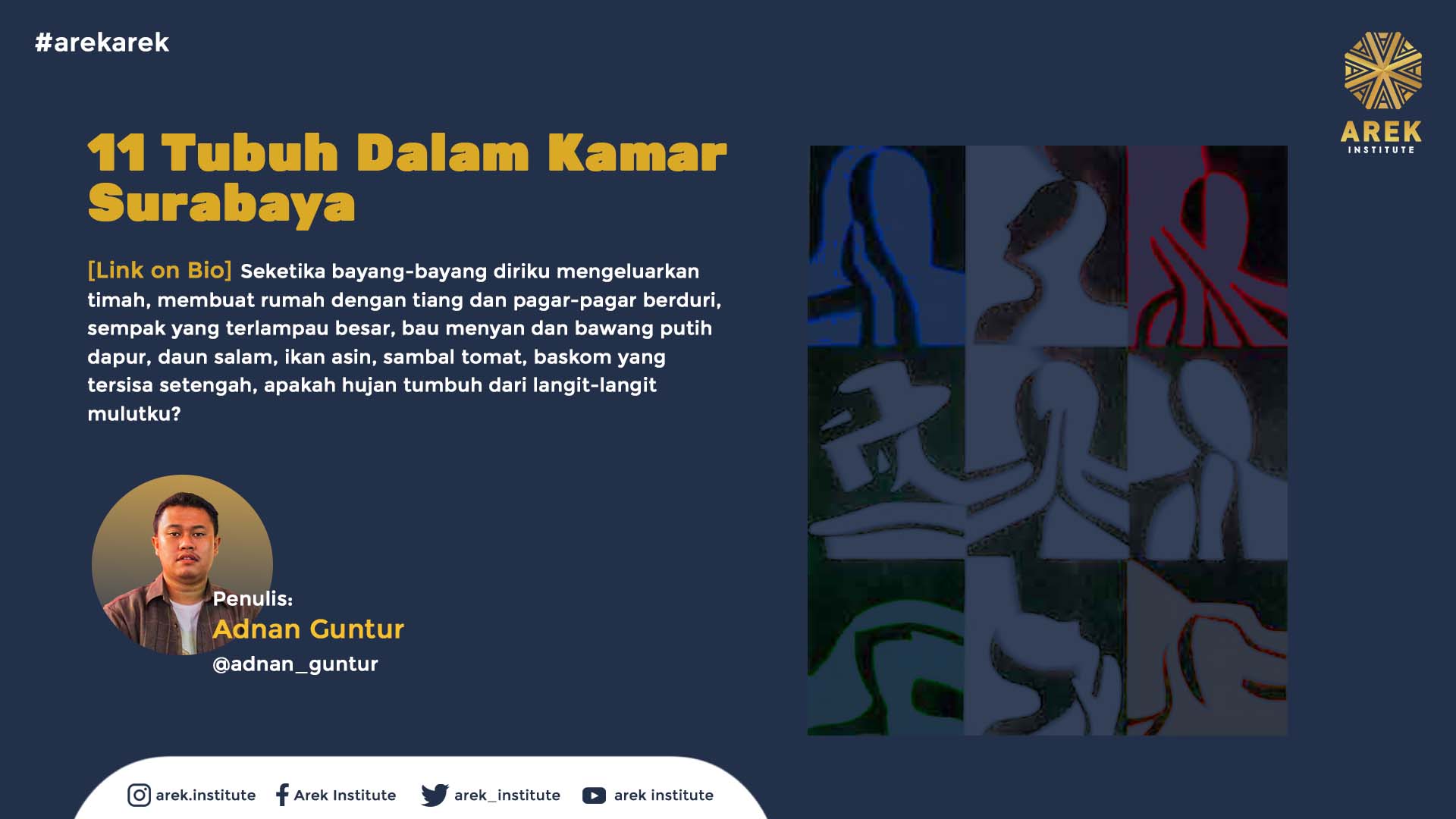
11 TUBUH DALAM KAMAR SURABAYA

di jendela, kakiku berloncatan dengan ikan juga di dalamnya, daun jatuh, sebuah batu kuning berubah menjadi abu, o, ketika malam mataku melihat mataku sendiri bermain-main dalam gerak yang statis, arah awan, bus-bus kota, kotoran kambing, knalpot bising, menampilkan dirinya menjadi sesuatu yang amis, kapal-kapal berlayar melampaui hujan yang berwarna hitam, o, apakah tuhan menjadikan dirinya sendiri dari dirinya sendiri, apakah sejarah di keningku menjadi berbahaya dan mengkilap, o, di jendela aku sering melihat anak-anak diculik dalam mimpinya, sepak bola melalui tiang basket, pohon-pohon di atas dasbor, o, seketika bayang-bayang diriku mengeluarkan timah, membuat rumah dengan tiang dan pagar-pagar berduri, sempak yang terlampau besar, bau menyan dan bawang putih dapur, daun salam, ikan asin, sambal tomat, baskom yang tersisa setengah, apakah hujan tumbuh dari langit-langit mulutku? apakah sebuah tangan melahirkan ibu dan ibu yang lain? apakah teleskop bisa menangkal kepunahan? tampilan di tivi membuatku bosan, ekonomi turun, pendidikan mundur, dimana aku bisa membeli masker medis bergambar spongebob? Gelas kaca ada kantong celana, air mata tumpah, mata air kehilangan harga diri, tembok tetangga, seng rombeng, tiang listrik, gembok angka tidak bisa dipakai menghasilkan crypto, kispray adalah semprotan kaca tukang cukur sebelas ribuan, habis merogoh kocek, menampilkan daftar harga dan gambar-gambar rambut, menjadi wanita atau laki-laki, o, bagaimana bisa aku melihat kepalaku sendiri? Bagaimana bisa aku mendefinisikan aku sendiri? anjing, babi, sabuk, karet, kipas angin berputar 360 derajat menuju timur lalu ke barat lalu ke selatan lalu ke utara

Surabaya, 2021

MENCARI MANUSIA DARI TUBUH URBAN

motor dari mobil dari manusia dari kota tumbuh, setelah 60 menit, sejarah berubah menjadi air, tong dan gerbong kosong seperti labirin yang mau dicari penjelasannya, dengarkan, masa depan kita melihat diri kita sendiri, tertawa di kapsul waktu, sperma menembak virus, listrik tertempel melalui galon, rel kereta mendengarkan dirinya melalui telinga, mendengarkan suara terjauh, meninggalkan jejak dan kematian tumbuh, sebuah pasar menawarkan dirinya sendiri dengan harga rendah, supermarket atau mall adalah peredam cuaca, lampu, bohlam, free masuk kamar mandi, mushola berada di bagian terbawah bumi, setrikaan mengantarkan dirinya sendiri ke etalase toko yang kusut, selalu melihat lalu menggambar lalu menjiplak lalu copy paste tercipta, tugas semakin mudah dikerjakan, buku hangus dan diberantas, masuk ke dalam sel karena asal ketik, isi otak kosong, apa yang mesti diperhatikan, mimbar pidato, koran kertas, buku elektrik, baliho, jalan raya menghasilkan citraan kita dari satu dan titik dua yang menghastag dirinya sendiri melalui search engine

Surabaya, 2021

MESKI KE ASAL KITA MELIHAT TUBUH LAUT 

balok dan besi digeser sedikit menghadap matahari, pasir berkilauan, batu merah dimakan kepiting yang bergerak menyamping, pohon kelapa sudah dimakan usia, masuk ke dalam botol berisi jin, sedikit lagi, kita akan melihat matahari tumbuh dari mata kita, jam empat sore, kelabang keluar dari vagina perempuan yang memakai sunscreen, asal kita tahu, sedikit lagi, air merambah naik, ikan-ikan ketepian melihat makanan seperti mie instan, sayur asem, kopi pahit, kopi manis, baju warna hijau, seseorang terseret dibawa kedalam laut, nelayan melempar jaringnya lalu tersangkut, sedikit lagi, wartawan berdatangan, meminta mulai, jalan-jalan dari sudut indonesia, bikin jalanan macet, seminggu, sebulan kemudian tetap tayang di tivi, tanpa sensor, situs deep web diretas bocah kecil yang anxiety, pukul duabelas dipotong umur nabi, tidak mengenal namanya, apakah kematian tidak mengenal dirinya sendiri, apakah kematian tidak menurunkan nabi dari sorga, sebentar lagi, mulai dari mana seharusnya kita berbicara, kepada siapa kita berbicara, sebentar lagi, kaki kita menyangrai kepala dengan garam yang disarankan penganut agama, segalanya terlihat tidak jelas, membuka celana dan pintu jendela tuhan (atau tuhan sudah mati sebenarnya) yang datang melambai menggunakan sampan, disana

Surabaya, 2021

MEMBELI GALON MENGGUNAKAN TUBUH DARI TUHAN

orang-orang membaca tubuhnya melalui kembali dari depan dan belakang, suara hujan atau pohon-pohon semakin tumbuh ketika tubuh bergerak ke entah mana, nama-nama ikan, berkeliaran dibuku pelajaran sosial dan agama, kemana lagi seseorang harus memahami keteguhan hati tuhan dari sedotan plastik, suara gema, telur dari lumpur, orang-orang kian amis, tubuhnya dipenuhi merkuri, namun di jendela atau dipinggir jalan, seseorang mungkin menduduki dirinya sendiri menggunakan air liur, permen karet, daftar kasbon, jalan-jalan sepi yang memutar dirinya sendiri untuk dilewati, apakah kesepian bisa menimbulkan kelelawar dan kupu-kupu pada seutas dasi ataupun kostum? apakah kita dapat mengenali kita yang lainnya? suara orang-orang semakin serak karena bingung mencoba untuk mengenali dari siapa ke siapa, sesosok lalu sesosok tubuh lagi berdiam diri ditengah jalan dengan orang-orang yang bergerak ke depan dan belakang, mencari tubuhnya yang berserakan

Surabaya, 2021

TUBUH YANG BERGERAK DARI DEPAN DAN BELAKANG

aku mesti mengenal diriku, sebuah cahaya melewati keliaran pikiran dan tembok yang patah, kaca mobil melihat pintu dan kursi penumpang, stasiun antar kota mengantar kepergian dengan kepulangan, sopir bus, sebungkus rokok, pom bensin, mengenal keberadaan keberangkatan yang tidak diketahui siapapun, aduh, mesti saja aku mengenalmu, tapi mengapa aduh, aduh, aku melupakan diriku sendiri, salon kecantikan, rambut botak, semir jenggot, menggauli listrik dan gunting, kepalaku di krimbat menggunakan air, minyak sambel, karbondioksida, mie ayam, gorengan, menjadi sarapanku pagi hari, semestinya uang bisa turun kapan saja, menggunakan tangan yang di barcode, tokok minuman, koin logam, melibatkan dirinya dalam pertarungan, antrian berdesakan, melewati pagar, labirin uang jajan, kolong jembatan, dan comberan menghiasi kota besar, aku seharusnya mengenal diriku sendiri, kaki kanan dengan kaki kiri, hadap kanan dengan hadap kiri, mencari barat mencari Timur, bubur diaduk bubur tidak diaduk, bengbeng dingin bengbeng biasa, sepatuku macet, bertumpukan diantara uang kas agama yang mencari penganut dari jendela ke jendela

Surabaya, 2021

The Existence of Arek Surabaya during the Colonial Period

The Existence of Arek Surabaya during the Colonial Period

Anugrah Yulianto Rachman–Nugi. Peneliti Arek Institute.

Colonialism has shaped the structure of the city of Surabaya, including the aspect of living space. The creation of this city structure has led to the emergence of a boundary between the urban area and the village. This spatial limitation significantly influenced the emergence of Arek Surabaya. For instance, this phenomenon is explored in William H. Frederick’s work titled “City Views and Turmoil: The Birth of the Indonesian Revolution (Surabaya 1926-1946)” (1989).

Frederick traces the history of Surabaya, starting from 1906, a period marked by decentralization due to ethical political policies. This led to the colonial government transforming the city into a Gemeente (Municipality).

Unfortunately, the transformation of Surabaya into a Gemeente further exacerbated inequalities for Arek Surabaya at the time. These inequalities stemmed from the division between Europeans and natives (inlanders), granting special rights to European residents. Although Arek Surabaya and Europeans lived within the same city boundaries, the native residents did not enjoy equal rights as city dwellers.

Moreover, the shift in governance led to rapid modernization in city development, such as the construction of modern ports, clean water purification systems, electric tram transportation, and paved roads. On one hand, Arek Surabaya, as city residents, became “outsiders.” For example, they lived in different land categories from the Europeans.

This difference in land categories is evident in the living spaces of Europeans. It emerged from the distinction between European elite residences and those of the natives. The Darmo area, for instance, was an elite residential complex for Europeans, developed with amenities like zoos, wide asphalt roads, and luxurious houses. In contrast, Arek Surabaya had to settle in spaces within the city that were untouched by municipal development, termed as villages. The natives had to build their civilization and culture within these environments.

Although the concept of a village may seem similar to that of a rural area, they differ in social cohesion and population density. Frederick highlights the social bonds within these village communities, rooted in the background of Arek Surabaya.

Frederick views Arek Surabaya not as a unified ethnic or social group but as migrants and settlers who share a common outlook and tradition, characterized by courage, realism, and material progress. This distinction is not only related to social cohesion in the villages but also marked by differences in living spaces between the village and the city.

Villages within Surabaya are directly bordered by the urban areas of the city. These boundaries are visible and clear, such as large walls, paved roads, or large buildings in European residential areas. All these physical objects have created a separation between village and urban spaces.

In specific cases, such as in 1929, Arek Surabaya was given living space in the Keputran area. The colonial government observed that village life had become increasingly crowded, so the native population needed to be provided with more suitable living spaces. However, the population density could not compete with the concrete jungle in Surabaya, such as restaurants, shops, hotels, and large houses owned by the Dutch.

The Keputran settlement case proves that the relationship between villages and urban areas has created visible boundaries (tangible-border). This marks the peripheral living space of Arek Surabaya. Even in 1921, the Dutch government was already aware of the need to relocate villagers from business centers and Dutch residential areas to more peripheral locations.

The creation of living space boundaries between the village and the city in the Keputran case is a manifestation of the emergence of Arek Surabaya based on the binary relation of city/village. The presence of these boundaries, such as concrete jungles in between, has created stereotypes about the Arek community living in villages.

Thus, according to Frederick’s research, Arek Surabaya emerged from the creation of living space boundaries in the colonial city. They are considered the Other in the context of Surabaya’s development, then dominated by Dutch colonialists. Villages were “left behind” or “marginalized” amidst the city’s progress, marking the term Arek Surabaya with a stigma of village life.

In short, the emergence of Arek Surabaya is actually a social pathology resulting from the city structure built by colonialism, causing Arek Surabaya to occupy a narrow space between urban areas, namely the village.