Making Ludruk the “Ambassador of Time and the Ambassador of the Masses”- Ludruk Lekra Plays, the Cultural Offensive, and the World of Ludruk after 1965
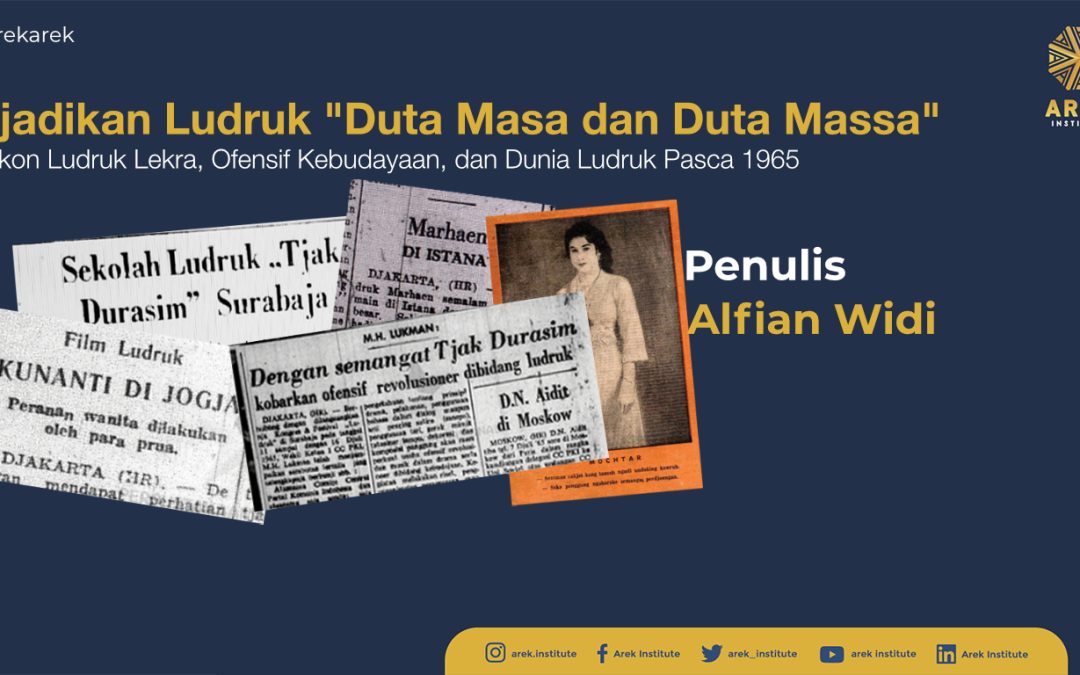
“Stopping by Semarang, stopping by Kudus,
Buying a broom with a wire string,
In a time of struggle don’t just flaunt appearances,
Let’s seize West Irian.”
Pribadi & Pakarti: Mochtar, Waspada No. 7, Year XI, 16 February 1962
In the previous article, it was discussed how the Institute of People’s Culture (Lekra) expanded people’s culture as a medium for raising public awareness. This article, therefore, will at least discuss the interrelation between Ludruk Lekra plays, the cultural offensive, and how they eventually culminated in the catastrophe of the 1965–1966 massacres, as covered by Tempo in its edition “Lekra and the 1965 Turmoil.” On the other hand, this paper also aims to include a discussion of the impact of the 1965–1966 mass killings on Ludruk plays after 1965, as the two are interrelated and have repercussions for one another.
Alongside the limitations of available sources, this article seeks to reconsider the existence of the controversial plays once performed by Ludruk Lekra in the 1960s. Drawing on the hypothesis elaborated by Saskia Wieringa and Nursyahbani Katjasungkana, it is suggested that Lekra’s cultural offensive in rural areas through Ludruk was an effort to criticize the landlords—who, in this context, happened to be closely connected with Islamic boarding school clerics.
As posed by the main question, this article seeks to present a more holistic discourse on Ludruk Lekra, considering that to this day, narratives about Ludruk Lekra still revolve around the cultural offensive and, inevitably, remain tied to negative connotations.
Agrarian Reform in Lekra’s Artistic Practices
Rocamora, in his book Nationalism Searching for an Ideology: The Rise and Fall of the Indonesian National Party 1946–1965, notes that the PKI along with other leftist movements, by the early 1960s—when agrarian reform became a heated issue—relocated most of its cadres to rural areas. This caused SOBSI (the All-Indonesia Central Organization of Workers), which was concentrated in urban areas, to fall into a disadvantaged position (Rocamora 2021).
This also occurred within Lekra as a left-oriented cultural organization at the time. Several Lekra members carried out the Turun ke Bawah (Descent to the Masses) method in order to immerse themselves in the lives of peasants when agrarian reform discourse spread throughout the country.
This was reflected in the large number of works of art and literature. In the field of graphic arts, for example, rural discourse was far more dominant than urban problems. In literature, there was an anthology of poems published by the Institute of People’s Culture Publishing under the title The Death of a Farmer. One work by Agam Wispi titled Latini represented the writers’ alignment with the agrarian reform struggle in Jengkol, Kediri, where the action killed a pregnant woman named Latini (Wispi 1961). On the same topic but in a different medium, Amrus Natalsja created a painting titled The Jengkol Incident.
This shows the concentration of Lekra’s artists and writers on rural issues, especially since the second half of the 1950s. Even so, a historiographical critique was raised by Elly Kent in her book Artists and Indonesian Society: Ideologies of Indonesian Visual Art (2024), which states that often Lekra artists did not actually have time to conduct turba and were instead preoccupied with producing propagandistic works (Kent 2024).
What Elly Kent highlights raises a major question that must be reconsidered: which works contain real lived reality, and which were merely propaganda? This is due to the bias of works that tend to be decontextualized, along with the limited archives or sources to verify the scattered data.
On the other hand, it was indeed necessary for Lekra artists to follow the political conditions year by year, since one of Lekra’s main principles stated: “Politics is the commander,” or in Njoto’s words, “Politics can proceed without culture, but culture will die without politics” (Document (I): First National Congress of the Institute of People’s Culture, 1959). The term ‘politics’ clearly referred to the revolutionary politics of the PKI and Lekra itself. For example, in 1964, Aidit published a book titled Crush the Seven Demons of the Village (1964), the result of his turba research in rural West Java. Soon afterward, artistic and literary groups followed the political campaign of “crushing the seven demons of the village” as the basic guideline for creation (Aidit 1964).
In the case of Ludruk, Elly Kent’s view can serve as a benchmark for reconsidering to what extent Lekra’s discourse and methods influenced Ludruk’s creative process. This is especially relevant given that the Ludruk plays reported in Harian Rakjat on 28 March 1965—perhaps the only news that published the contents of “leftist” Ludruk plays—were very diverse, and did not merely narrate rural conditions.
Ludruk Lekra, Two Heights, and the Material Conditions of Rural East Java in the 1960s
In addition to the principle of “good traditions and revolutionary contemporaneity,” there was also a work combination referred to as “high ideological quality and high artistic quality”—often shortened to two heights. In Lekra’s artistic practice, two heights became the most basic guideline, especially in countering the “art for art’s sake” group, which often judged that politically engaged art was artistically weak. Therefore, this section will attempt to explore the “leftist” Ludruk plays both ideologically and aesthetically. At the same time, it will also show practices that were considered forms of cultural offensives, as echoed by anti-communist groups after 1965.
In Harian Rakjat, 28 March 1965, it was recorded that when Ludruk Marhaen went to Jakarta, at least four plays were performed: Pak Sakerah, Waves of Trikora, Seven Demons, and Dr. Oei Tik Liong. These four plays can be classified into two categories: classical plays such as Pak Sakerah, and newly created “leftist” Ludruk plays such as Waves of Trikora, Seven Demons, and Dr. Oei Tik Liong (Harian Rakjat 1965).
This classification can be clearly seen in the titles. The play Pak Sakerah had already become a legend of popular resistance in the colonial era—similar to the play Sarip Tambak Oso, which likely took place during the rise of capitalism in the Dutch East Indies under the Agrarische Wet and Suiker Wet of 1870. In contrast, the other three plays were creations made by Ludruk itself, reflecting the political agendas of the left at the time: the Tri Komando Rakyat (Trikora) operation known as an anti-colonial action; the “crush the seven demons of the village” discourse initiated by Aidit; and anti-racist politics in the play Dr. Oei Tik Liong. Through these four plays, it can be shown that leftist Ludruk was experiencing rapid development in creating new works that continued its own revolutionary tradition.
These plays demonstrate that politics and the material conditions of society always accompanied the process of artistic creation, or in the language of the work combination: “high aesthetic quality and high ideological quality.” This effort was clearly a mandatory duty for Lekra members in the creative process. This was evident not only in the production of plays but also in the creation of kidung and parikan (traditional verses). According to Waspada: Kalawarta Basa Jawa No. 7, 16 February 1962, in the “Pribadi & Pakarti” column which discussed Mochtar as a Ludruk artist, one of the verses he performed was included:
“Stopping by Semarang, stopping by Kudus, buying a broom with a wire string. In a time of struggle don’t just flaunt appearances, let’s seize West Irian.” (Waspada: Kalawarta Umum Basa Djawa 1962).
In that column, it was told that Mochtar was a Ludruk artist who usually performed as a transvestite actor in the Ludruk Tresno Enggal group based in Surabaya. Through the verses sung by Cak Mochtar, it is evident that in their effort to enhance the revolutionary tradition within Ludruk, the Tresno Enggal group, which was affiliated with Lekra, even created verses infused with revolutionary contemporaneity.
On the other hand, there were also aesthetic explorations conducted by Ludruk groups in various regions, especially in Surabaya. According to a report by Bambang S.W. in Harian Rakjat Minggu, 24 May 1965, a Lestra Surabaja discussion took place on experimental Ludruk drama by the Ludruk Tresno Enggal group to celebrate the PKI’s anniversary on 23 May 1964 (Bambang SW 1964). The meeting, held on 13 May 1964, was described by Bambang SW as a special session because it concerned aesthetic advancement within Ludruk itself.
The discussion raised several important points for Ludruk’s progress at the time. The most basic question asked was: “Will Ludruk always be labeled as ‘cheap art’ and thus never be accepted by intellectuals?!” From this, Bambang S.W. explained the structural weaknesses of Ludruk narratives, especially the use of satirical humor, which, according to the session, undermined the plays as a whole:
“This is one of the reasons why Ludruk fails to satisfy audiences who want answers to the problems lingering in their minds; and this is also why Ludruk seems only to fulfill the taste for laughter” (Bambang SW 1964).
Therefore, the meeting produced a noteworthy conclusion: Ludruk artists must remain aware of the material conditions of the society in which they perform, and they must carefully place their humor so that it does not destroy the dramatic structure. Indirectly, this session opened space to merge theories and structures of modern drama with the folk performance art of Ludruk.
Furthermore, in the months just before the 1965 catastrophe, Ludruk had already come under party patronage. According to Harian Rakjat (28 March 1965), Ludruk was to consistently implement the mandates of the Conference of Revolutionary Literature and Arts (KSSR). This shows that Ludruk became increasingly ideological and revolutionary, aligning with the aesthetic and ideological guidelines of the KSSR. It is therefore possible that offensive plays such as The Death of God (Matine Gusti Allah) were indeed performed—although it can be assured that these controversial plays did not in any way intend to mock God, as was later propagated after 1965.
Before moving to the next section, it is worth considering controversial plays like The Death of God and The Angel Marries as historical facts, which can then be contextualized within Ludruk’s aesthetic explorations and efforts to heighten ideological content.
Referring to the writings of Saskia Wieringa and Nursyahbani Katjasungkana as well as Tempo’s reporting on Ludruk, such plays can be seen as part of leftist Ludruk’s attempt to achieve two heights (Wieringa and Katjasungkana 2020). Ludruk’s efforts to criticize Islamic groups, particularly clerics, certainly carried intent.
In the rural context of the time, land reform efforts failed to reach fair agreements, especially in facing oppressive landlords who refused to surrender land as mandated by the 1960 Agrarian Law (Achdian 2008). Many of these landlords were clerics themselves, so it is not surprising that Ludruk voiced such critiques, echoing Marx’s famous statement: “Religion is the opium of the oppressed masses.” For leftist Ludruk, the clerics had clearly deviated from the liberating conception of religion, as they sided neither with poor peasants nor with other oppressed groups.
One case illustrates this: in early 1965, a brutal murder took the life of Matali, an activist of the Indonesian Peasants’ Front (BTI) in Jombang. He was killed by right-wing groups (in this context, pro-Masyumi elements and hired thugs) because of unilateral land actions carried out by Matali and other BTI activists (M. 1965).
On the other hand, the offensive measures taken by leftist Ludruk were indeed excessive, especially among the rural lower classes. It can thus be concluded that the consensus to “be Ludruk artists who know their place,” as reached in the second Lestra Surabaja discussion, was not well distributed to other regions.
Therefore, these controversial plays can be interpreted as one of the consequences of land disputes that persisted from 1960 to 1965, in which the two main rural elements—communists and religious groups—confronted each other. It is thus unsurprising that plays like The Death of God became symbols repeatedly invoked in post-1965 discourse as representations of PKI brutality, even though such claims cannot be properly substantiated.
A Post-1965 Overview: Lying Low and Shadowed by the Military in the Arts
After the total suppression of the leftist movement in 1965–1966, the most visible impact was how artistic and cultural activities immediately came to a standstill, at least between 1966 and 1968 (Tempo 2013). Many were afraid to return to artistic practice out of fear that their names would be listed by the authorities—considering that such “name-dropping” became one of the most terrifying threats during those violent years, when wrongful arrests were rampant (Bustam 2022).
When that period of violence subsided, coinciding with the rise of the military strongman Suharto, artistic activity fell under the shadow of militarism. Many regional performing arts groups were directly overseen by the military at the level of Regional Military Commands (Kodam) or District Military Commands (Kodim), such as Ketoprak and Ludruk itself (Tempo 2013).
This section will briefly discuss the transformations and discourses that spread at that time, given that the propaganda of the New Order was often voiced through everyday folk culture such as Ludruk and Ketoprak. This discussion will only present processed data and interpretations from a recent conversation. This short overview at least opens space to reinterpret the transformation of Ludruk discourse, which seemed filled with both politicization and depoliticization of folk culture.
During the transition from the Sukarno era to the Suharto era, there was a major shift in the realm of folk performance, as evident in the content embedded within it. In the Sukarno era, Ludruk performances were always tied to Indonesian political agendas and Lekra. Under Suharto, however, Ludruk became a propaganda tool for the Golkar party and the New Order regime.
According to the account of S.B., a former technician for the Ludruk Putra Bhirawa group under the supervision of the Jombang Kodim, Ludruk during the New Order could be described as a mouthpiece for Golkar’s electoral victories and New Order propaganda itself.
S.B., as part of military-controlled Ludruk, also realized that Ludruk had been weakened. Its function as a medium of criticism toward those in power was curtailed. In the New Order era, S.B. added, Ludruk typically dared to criticize only at the level of the village head (lurah) or sub-district head (camat), but never beyond, because that would mean dealing with security forces and imprisonment (Interview with S.B., 2025).
Another aspect worth further attention is the way the New Order inserted its political agendas into Ludruk plays. As a historical witness, S.B. explained that New Order propaganda in Ludruk was inserted through jokes delivered by Ludruk performers themselves:
“Once there was a Ludruk joke that went like this: ‘Golkar always wins because if you touch them just a little, they immediately bloom.’ There was also another: ‘There’s a long black thing.’ Another player asked curiously, ‘What do you mean?’ The answer came: ‘Well, it’s the New Order program itself. Asphalt is black, and it’s long, because the New Order will always succeed in building roads (from one end to the other)’.” (Interview with S.B., 2025)
In S.B.’s testimony above, it is clear that the humor leaned into sexual innuendo, under the pretext that such jokes were close to everyday popular humor. Clearly, the sexism of the New Order is visible here, which was also a continuation of the symbolic violence after 1965, especially through women’s domestication projects such as PKK (Family Welfare Movement), Dharma Wanita, and others (Wieringa 2010; Suryakusuma 2011).
S.B. also explained that colonial-era resistance plays were still staged during that time. However, this paper argues that such plays were maintained merely as formal conventions within Ludruk. Canonical plays like Pak Sakera and Sarip Tambak Oso were considered among the earliest in Ludruk’s historiography, so it was deemed incomplete not to include them in Ludruk performances during the New Order. On the other hand, the content of these plays was diluted or even lost, particularly their messages of grassroots resistance against power.
Thus, it can be understood that a massive transformation and depoliticization occurred in Ludruk after 1965, largely shaped by the politics of New Order authoritarianism—especially in terms of humor, gender positioning, and propaganda. While in the pre-1965 era Ludruk served as a revolutionary political tool of the left, the key difference post-1965 is that the leftist movement had sought to preserve good traditions within Ludruk through revolutionary contemporaneity. This allowed plays like Pak Sakera to remain alive as Ludruk’s canon, continuously breathing the spirit of small people’s resistance—rather than being reduced to mere formalities to demonstrate that Ludruk was simply a folk art of the egalitarian Arekan subculture.
From the Revolutionary Cultural Offensive to the Shift in the Role of Transvestites in Ludruk
The previous article sought to highlight one of the principles within the 1-5-1 formula, namely: “good traditions and revolutionary contemporaneity.” This meant that Lekra’s direction in cultural work was not to create an entirely new culture, but rather to combine traditions already rooted in society with tactics of social awareness (Dahlan and Yuliantri 2008). In this respect, Lekra did not fully alter the conventions, but modified the content—through scripts, additional storylines, or creating something new based on existing traditions.
This can be seen in several examples, one of which was briefly discussed in the first article. In terms of adding narrative content, Lekra made efforts to reinterpret Barongan art. In Harian Rakjat Minggu, 26 September 1965, it was reported that a local group from the village of Danyang near Purwodadi, together with the Purwodadi branch of Lekra, had modified the story content and technical aspects of performance (Harian Rakjat 1965b):
“The content of this folk drama narrates the struggle of the people against their enemies, represented as the seven demons of the village and the imperialists, who here are depicted in the form of the barongan (lion).”
In the art of Ludruk, the changes seemed limited to content and aesthetic techniques borrowed from modern drama. In Harian Rakjat, 24 May 1964, it was recorded that the Drama Arts Institute (Lesdra), which oversaw Ludruk, provided suggestions for advancing Ludruk so it could be better received by wider audiences (Bambang SW 1964). One main point in the third Lesdra discussion was the effort to develop plays that needed renewal so that Ludruk would not merely serve as a means of satisfying laughter—more importantly, so that Ludruk could also be accepted among intellectuals.
The notes from that session also discussed the possible elimination of women’s roles performed by men (transvestites), but the matter seemed left to the “spirit of the times”:
“Regarding men playing women, it may very well change according to the demands of the time and the masses. That depends on history.” (Bambang SW 1964)
That suggestion, however, seemed to evaporate, since Harian Rakjat (28 March 1965), reporting on Ludruk Marhaen at the State Palace, noted that actors still played women’s roles (transvestites). According to James L. Peacock, transvestites were an essential and inseparable part of Ludruk, as they served as the central figures in its rites of passage (Peacock 1987). Functionally, transvestites not only acted on stage but were also involved in technical work such as building the stage (tobong), and more (Setiawan 2014). Thus, their role was nearly indispensable.
The importance of transvestites in Ludruk is also evident in the Pribadi & Pakarti column, which discussed Tjak Mochtar, a transvestite actor from Ludruk Tresno Enggal in Surabaya. Tjak Mochtar was even regarded as someone who embodied the people’s spirit, because beyond his moving performances, his presence on stage always “ignited the spirit of struggle.”
“Besides that, Muchtar, whom we will introduce here, has also produced many works that inflame the spirit of struggle to return West Irian to the lap of Motherland.” (Waspada: Kalawarta Umum Basa Djawa 1962)
Here, it is evident that the role of transvestites did not stop at portraying women’s characters, but also in spreading political discourse, as James L. Peacock noted. Simply put, the role of the transvestite was not just to bring female figures into the domestic sphere, but also into the public sphere—even showing that women could participate in politics.
In Peacock’s research, although Ludruk excluded “real” women and replaced them with transvestites, he explained that the figure of the mother was consistently portrayed as the wisest character, surpassing male roles such as father or son (Peacock 1987). Often, transvestites represented maternal power, rendering paternal authority secondary and replaced by maternal dominance. For example, in the play Sarip Tambak Oso, the mother is depicted as possessing magical power or as “The Hero’s Mother,” indirectly conveying that no matter how formidable Sarip Tambak Oso was against colonial punishment and rifles, he remained alive or invincible due to his mother’s “calling” or “prayers.”
Similarly, in the play Pak Sakerah, performed by Ludruk Marhaen at the State Palace, one scene depicts Pak Sakerah killing his own nephew because the nephew had been recruited by the Dutch as a foreman, considered submissive—a Lumpenproletariat lacking self-awareness of his oppression (Harian Rakjat 1965). On the other hand, Pak Sakerah killed him also because the nephew persistently harassed his wife. Here it is shown that Pak Sakerah embodied loyalty, defending his wife’s honor with devotion.
This situation contrasts sharply with Ludruk during the New Order and afterward. The crucial role of transvestites as carriers of discourse and as figures of “female exaltation” shifted into being objects of ridicule or comic relief. Transvestites often experienced unpleasant treatment during performances. This reflects the New Order’s political agenda of dismantling women’s movements and women’s roles in the public sphere—an agenda that also marginalized LGBTQ+ communities, labeled as “deviant” in New Order discourse.
In conclusion, the emergence of discourse around plays like The Death of God (Matine Gusti Allah), used as justification that the left mocked God, was merely a reaction to the destruction of two heights within Ludruk itself, particularly after 1965. This comparative discussion shows that Ludruk declined especially in the New Order era, where it suffered extreme depoliticization and simplification. Once a revolutionary art, it was reduced to little more than Golkar and New Order propaganda, mere entertainment and humor without renewed evaluations to remain relevant to contemporary realities—or in Lekra’s words, “revolutionary contemporaneity.” In the end, the New Order, often idealized as a new era for the arts, proved to be nothing more than a dystopia for the artists themselves.
References
Achdian, Andi. 2008. TANAH BAGI YANG TAK BERTANAH: LANDREFORM PADA MASA DEMOKRASI TERPIMPIN 1960-1965. Bogor: Kekal Press.
Aidit, Dipa Nusantara. 1964. Kaum Tani Mengganjang Setan-Setan Desa. Jakarta: Jajasan Pembaruan.
Bambang SW. 1964. “SARASEHAN LESTRA SURABAJA KE-II: Tentang Eksperimen Drama Ludruk.” HR Minggu (Djakarta), 24 Mei 1964.
Bustam, Mia. 2022. Dari Kamp ke Kamp: Memoar Kedua. Bandung: Ultimus.
Dahlan, M. Muhidin, dan Rhoma Dwi Aria Yuliantri. 2008. Lekra Tak Membakar Buku: Suara Senyap Lembaran Kebudayaan Harian Rakjat 1950-1965. Yogyakarta: Merakesumba.
Dokumen (I): Kongres Nasional Pertama Lembaga Kebudajaan Rakjat. 1959. Bagian Penerbitan Lembaga Kebudajaan Rakjat.
Harian Rakjat (Djakarta). 1965. “Ludruk Marhaen di ibukota.” 28 Maret 1965.
Harian Rakjat (Djakarta). ——. 1965b. “Ludruk Marhaen di ibukota.” 28 Maret 1965.
Suryakusuma, Julia. 2011. Ibuisme Negara: Kontruksi Sosial Keperempuanan Orde Baru. Depok: Komunitas Bambu.
Kent, Elly. 2024. Seniman dan Masyarakat: Ideologi-Ideologi Seni Rupa di Indonesia. Jakarta: Penerbit Gang Kabel.
M., Lilik. 1965. “Djombang: Matali pahlawan tani pembela UUPA.” Harian Rakjat (Djakarta), 13 Februari 1965.
Peacock, James L. 1987. Rites of Modernization: Symbolic and Social Aspects of Indonesian Proletarian Drama. Chicago: University of Chicago Press.
Rocamora, Jose Eliseo. 2021. Nasionalisme Mencari Ideologi: Bangkit dan Runtuhnya PNI 1946-1965. Tangerang: Penerbit GDN.
Setiawan, Ari. 2014. “KONSTRUKSI GENDER TANDHAK LUDRUK SUROMENGGOLO: Studi Deskriptif mengenai Identifikasi Ekspresi Gender pada Tandhak Ludruk Suromenggolo Kabupaten Ponorogo.” Skripsi, Universitas Airlangga.
Tempo. 2013. Lekra dan Geger 1965. Dalam Tempo. Jakarta: Kepustakaan Populer Gramedia.
Waspada: Kalawarta Umum Basa Djawa (Jogjakarta). 1962. “Pribadi & Pakarti: Mochtar.” 16 Februari 1962.
Wieringa, Saskia. 2010. Penghancuran Gerakan Perempuan: Politik Seksual di Indonesia Pascakejatuhan PKI. Yogyakarta: Penerbit GalangPress.
Wieringa, Saskia E., dan Nursyahbani Katjasungkana. 2020. Propaganda & Genosida di Indonesia: Sejarah Rekayasa Hantu 1965. 1 ed. Disunting oleh Rahmat Edi Sutanto. Depok: Komunitas Bambu.
Wispi, Agam. 1961. “Latini.” Dalam Matinja Seorang Petani. Djakarta: Bagian Penerbitan Lembaga Kebudajaan Rakjat.